Is It Worth It in 2026? Our Scoring Method Explained
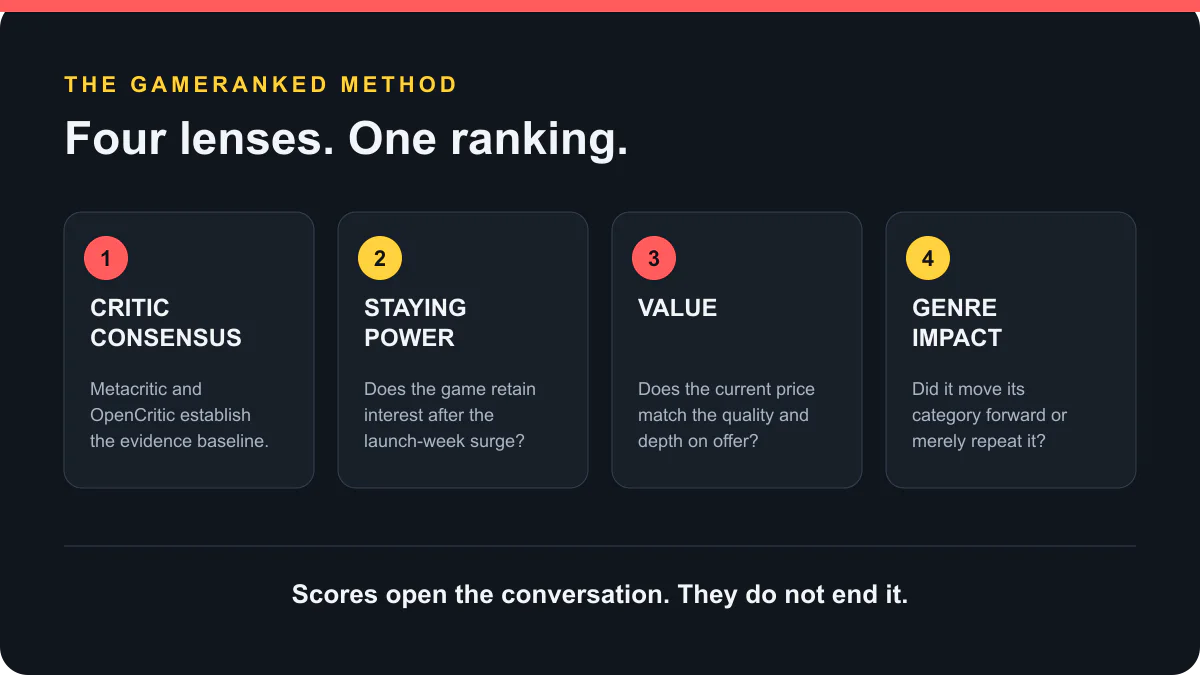
Image: GameRanked
Here is a question a review score cannot answer on its own: should you spend your money on this game, right now, at this price? A number like 88 tells you critics enjoyed it. It does not tell you whether anyone is still playing it two months later, whether the $70 price tag matches what you actually get, or whether the game moved its genre forward or just showed up. Those are the questions that decide “worth it,” and they are the questions we built our scoring method around.
Every ranking and tier list on GameRanked runs through the same process. This page is the full explanation, so you can see exactly what our scores mean and, just as importantly, what they do not.
Step one: start with the critic consensus
We begin where most people do, with aggregate scores from Metacritic and OpenCritic. These are a useful starting point because they smooth out any single reviewer’s bias and reflect a broad professional consensus. But we treat them as the opening of the conversation, not the verdict. Plenty of games score well at launch and fade fast, and the aggregate cannot see that coming.
Step two: adjust for the things scores miss
This is where our method earns its keep. We adjust the starting score for three factors that launch reviews routinely undervalue.
- Staying power. Is anyone still playing this two months on? A game that empties its servers or gets abandoned mid-campaign loses ground, no matter how it reviewed on day one.
- Value. Does the price match the payoff? A brilliant ten-hour game at full AAA price is a different recommendation than the same game at half off, or a $6 indie punching far above its cost.
- Genre impact. Did it push its category forward or simply execute the familiar? Games that raise the bar for everyone that follows earn a bump.
A game can review at 88 and still land a tier below an 86 if it fizzles, overcharges, or brings nothing new. Scores open the door; these three factors decide which room the game ends up in.
Step three: convert to tiers
Numbers feel precise, but a two-point gap rarely means much. So we translate our adjusted scores into tiers, because tiers communicate the honest truth: within a band, personal taste matters more than the decimal.
| Tier | What it means | Buying advice |
|---|---|---|
| S | Defines its genre or year | Buy it, full price, no hesitation |
| A | Excellent with no real caveats | Buy it, you will not regret it |
| B | Very good with a catch | Buy on sale or if the niche fits you |
| C | Decent but flawed | Wait for a deep discount |
| Skip | Not worth your time | Spend the money elsewhere |
What “worth it” actually depends on
The honest answer to “is it worth it” is “for whom, and at what price.” A niche tactics game can be S-tier for genre fans and a hard skip for everyone else. A great game at $70 can become an easy buy at $35. Our tiers bake in the general case, but we always call out who a game is really for, because a recommendation without an audience is just noise.
FAQ
Do you just copy Metacritic scores? No. We start with aggregate scores, then adjust for staying power, value, and genre impact. Our final tier often disagrees with the raw number, and we explain why when it does.
Why use tiers instead of a precise score out of 100? Because a 0-to-100 scale implies a precision that does not exist. The difference between an 86 and an 88 is mostly noise; the difference between an S and a B is real and useful.
Does price affect your ranking? Yes. Value is one of our three adjustment factors. A game’s tier can rise when it drops to a fair price and can sit lower while it is overpriced at launch.
How often do you re-score games? We revisit rankings monthly and immediately after major updates, price drops, or content additions that change the value equation. Every refresh is dated.
Sources
Published by BudLeiser.
scoring methodhow we rankgame reviews 2026is it worth ittier listvalue